Triple-certified hardware security modules from Sansec for banking, government, and regulated industries. Three HSM SKUs — general-purpose, financial, and FIPS 140-2 Level 3 — plus a transparent database encryption module. SM2 / SM3 / SM4 national commercial cryptography alongside RSA / ECC / AES. PBOC / EMV / JCB card-payment standards. Sansec cryptographic hardware, AGH channel delivery for Hong Kong and APAC.
Software keys sit in memory where they can be extracted. Cloud KMS endpoints extend trust to a public network. Compliance regimes — FIPS 140-2, PBOC, the self-controllable mandate, cryptographic evaluation — increasingly require the root key to live in a tamper-evident, FIPS-validated hardware module. The HSM is no longer optional; it is the contractual foundation of every cryptographic deployment.
FIPS 140-2, PBOC, cryptographic evaluation, the self-controllable mandate, the 0255 financial-sector standard — most regulated cryptographic deployments now require a hardware root of trust. Software-only key custody is not certifiable.
Sensitive data at rest, in transit, in use. The HSM holds the key — applications never see it. Tamper-evident chassis, hardened firmware, FIPS-validated entropy and RNG.
Banking, government, and domestic IT procurement mandates are pushing SM2 / SM3 / SM4 adoption. Thales, SafeNet, and other legacy HSMs are foreign and increasingly incompatible with PRC commercial-cryptography procurement. Sansec is the replacement path.
PKCS#11, JCE, CAPI, KMIP, PCI card-spec — Sansec implements all of them with SM algorithm extensions added. Existing applications stay green; no source-level refactor required.
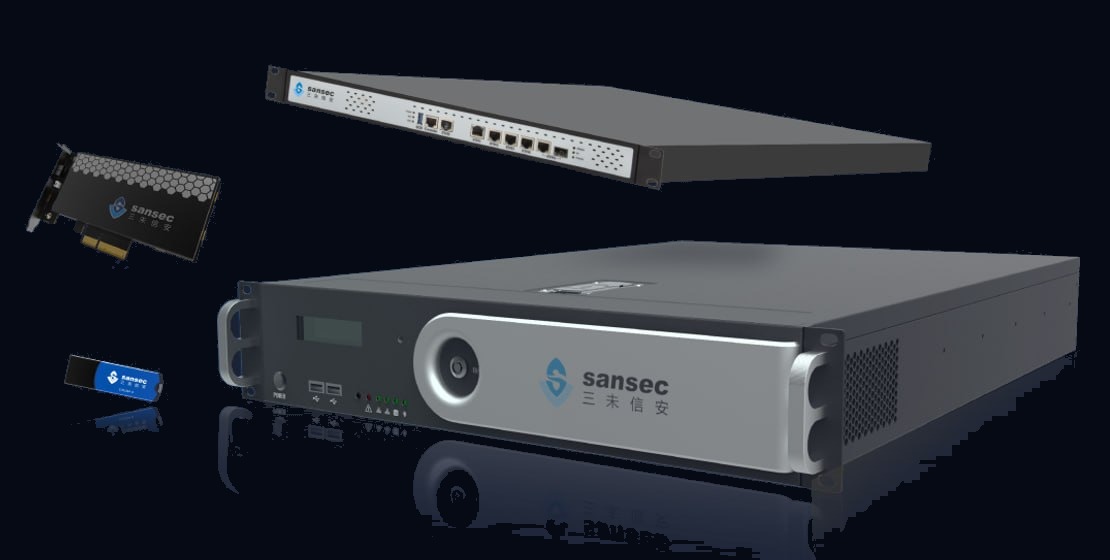
General-purpose HSM for government, healthcare, education, and energy. Financial HSM for banking, payment, and clearing — built to PBOC / EMV / JCB card-payment standards. FIPS 140-2 Level 3 HSM for FIPS-required environments and replacement of legacy modules. A transparent database encryption module for cryptographic-evaluation-grade data-at-rest protection.
Key generation, encryption / decryption, signature / verification, hash and integrity computation. The default HSM for sensitive-data protection across government, healthcare, education, and energy.
Supports PBOC, EMV, and JCB card-payment specifications. Built for banking core systems, payment processors, and financial clearing institutions. PBOC / UNIONPAY / NUCC state-crypto commands in the PCI card-spec layer.
Sansec HSM Cryptographic Module — FIPS 140-2 Level 3 certified. High-assurance deployment in FIPS-mandated environments; pairing commercial-cryptography counterpart modules for commercial-cryptography-certified projects in the same vendor envelope.
Transparent database encryption, deployed between the application and database. Same key-management plane as the HSM family — cryptographic-evaluation-grade data-at-rest protection without rewriting application SQL.
Sansec HSM delivers the full international crypto stack alongside the full SM algorithm stack. No algorithm negotiation at deployment time — both stacks are resident. Banks running RSA-based card systems today, who must adopt SM2 / SM3 / SM4 by the regulator's deadline, can stay on the same hardware.
DES / 3DES / AES symmetric, MD5 / SHA-1 / SHA-2 / SHA-3 hash family, RSA / ECC asymmetric. The standard international crypto stack — fully interoperable with Thales, SafeNet, AWS CloudHSM, Azure Dedicated HSM.
Full SM-algorithm coverage — symmetric (SM4), asymmetric (SM2, SM9), hash (SM3). Required by the Cryptography Law for critical infrastructure, by cryptographic evaluation for government and medical systems, by the self-controllable mandate for centralized procurement, and by PBOC Document 140 for banking.
Sansec provides key-migration tools. When the HSM vendor changes, application keys move into the new module — and data previously encrypted with the original keys needs no re-encryption or scrubbing. The replacement is data-friendly.
Shor's algorithm (1994) breaks RSA, ECC, and SM2 in polynomial time. NIST finalized FIPS 203 / 204 / 205 in 2024 — ML-KEM (Kyber), ML-DSA (Dilithium), SLH-DSA (SPHINCS+). The Sansec HSM is the cryptographic anchor for the migration: hybrid SM2 + PQ operation, dual-signature certificates, and PQC-enabled TLCP / IPSec / SSH protocols — staged over a regulator-aligned timeline.
NIST FIPS 203 (ML-KEM / Kyber), FIPS 204 (ML-DSA / Dilithium), FIPS 205 (SLH-DSA / SPHINCS+). China competition: Aigis-enc, Aigis-sig (gold), LAC.PKE, CTRU, LMS-SM3. Five NIST-tracked mathematical foundations — lattice, hash, code, multivariate, isogeny — all under one vendor envelope.
Dual-algorithm certificate: SM2 + PQC signature. Verification requires both signatures to pass — no orphan assets, no re-issuance cliff. Backward-compatible with existing SM2 PKI. The certificate format change is the only out-of-band step.
TLCP (GB/T 38636-2020) with PQC cipher suites. IPSec with PQC key encapsulation. SSH with PQC key exchange. Existing PKI / CA / VPN deployments upgrade the protocol layer without replacing endpoints.
Cryptographic agility design: configurable algorithm layer. Hybrid transition: SM2 + PQ run alongside. Final cutover: PQC-only when the regulator mandates. AGH delivers the migration roadmap, runbook, and timeline aligned to your procurement cycle.
Three Sansec HSM SKUs plus the database encryption module collectively cover the cryptographic-certification stack that HK, mainland, and APAC regulators most frequently reference. Procurement can map regulatory needs to SKU without juggling vendors.
Sansec HSM Cryptographic Module is FIPS 140-2 Level 3 certified. Required for financial institutions, payment processors, and any deployment where foreign regulators mandate FIPS-validated hardware.
All Sansec HSM SKUs are available with commercial cryptography certification. The Cryptography Law mandates commercial cryptography for critical infrastructure — cryptographic evaluation validates the application against the underlying SM-algorithm module.
Financial HSM (HSM-F) supports PBOC, EMV, and JCB card-payment specifications. Required for issuing, acquiring, clearing, and card-personalization systems. UNIONPAY and NUCC state-crypto commands added in the PCI layer.
Every Sansec HSM product category is available in a self-controllable-compliant version. Cross-vendor mutual-recognition across CPU, OS, database, and middleware is the standard procurement pattern.
Sansec HSM is the underlying cryptographic module for cryptographic-evaluation-scoped business systems — government, healthcare, education, energy, and other critical infrastructure. Pair with industry-standard cryptographic-evaluation testing toolkits (zero-trust probes, integrity monitors, scan engines) for evaluation readiness.
Comprehensively SM-algorithm-mandated for banking. PBOC Document 140 mandates full SM-algorithm adoption for important systems, IC card SM support, and commercial cryptography certification of cryptographic products. 0255 is the financial-sector commercial-cryptography implementation standard.
On the same PKCS#11, JCE, CAPI, and KMIP interface layer, the application doesn't know the HSM has changed. Sansec provides key-migration tools so the application keys move into the new module — and data previously encrypted with the original keys needs no re-encryption or scrubbing. Replacement is data-friendly.
CAPI, JCE, PKCS#11, KMIP, PCI card-spec — the same calls, the same return codes, the same key handle model. Applications port by config change, not by source change.
Migrate application keys from the source HSM into the Sansec module. RSA, ECC, AES, and SM-algorithm keys supported via the standard interface layer. No proprietary import path required.
Because the original keys arrive intact and the existing ciphertext retains its origin, archived data is readable on the new HSM without scrubbing, re-encryption, or batch migration windows.
New HSM serves alongside the legacy HSM for a defined period. Application traffic splits, then cuts. Rollback is possible any time before final cutover. AGH delivers the migration plan and the cutover runbook.
Every standard cryptographic service interface is implemented on the Sansec HSM, with national commercial cryptography added in the same API surface. Application teams stay on the interfaces they already use; the regulator's commercial-cryptography requirement is satisfied at the HSM layer.
CAPI on Windows OS, plus SM algorithms. Drop-in for Windows applications and CA infrastructures.
JCE provider for Java runtimes, plus SM algorithms. Java application servers, ESB, and Spring-based stacks plug in directly.
Industry-standard PKCS#11 interface, plus SM algorithms. The default integration path for cryptographic applications in finance, government, and enterprise SaaS.
KMIP standard key-management protocol. Storage platforms with built-in KMIP client reach the HSM transparently. BYOK and HYOK patterns natively supported.
PCI card-spec command set, plus PBOC / UNIONPAY / NUCC state-crypto commands. The financial-HSM interface for card issuance, personalization, and payment-switching.
The Sansec HSM family's three-pronged direction — data-security construction, equipment replacement, and banking — maps to the procurement patterns most HK and APAC buyers carry. Below is the natural fit, not a sales pitch for every vertical.
HSM-F (Financial) for issuing, acquiring, clearing, and international clearing-center integration. PBOC Document 140 mandates full SM algorithm adoption; 0255 is the implementation standard. Cloud-native is the trend for new builds.
HSM-G (General) for sensitive-data encryption, identity authentication, and document protection. The Cryptography Law, the Data Security Law, and the Personal Information Protection Law collectively raise the bar for cryptographic infrastructure; cryptographic evaluation is the validation gate.
Patient data, medical imaging, prescription records — all sensitive, all subject to the Personal Information Protection Law. HSM-G (General) roots the key for encryption at rest; HSM-DB adds transparent database encryption for medical records systems.
Critical infrastructure — power grid, oil & gas, water. Explicit Cryptography Law coverage, cryptographic-evaluation-mandated deployments. HSM-G (General) plus HSM-DB for SCADA-side data protection and audit-log integrity.
AGH delivers Sansec HSM across Hong Kong and APAC as the authorized channel partner. We don't drop-ship boxes — we deploy them. Our team works with yours on SKU selection, algorithm-stack mapping, virtualization-PKI / KMS / signing-server integration, key migration from legacy HSMs, and cryptographic-evaluation-supporting compliance documentation for cross-border handovers.
Delivery covers English / Simplified Chinese / Traditional Chinese. Cross-border deployments are AGH's steady state: HK + mainland + APAC, Sansec hardware, AGH-local engineering.
30 minutes with our team. We'll review your application stack, current HSM estate, regulatory obligations (FIPS, PBOC, commercial cryptography, self-controllable, cryptographic evaluation), and algorithm-transition timeline — and propose the right Sansec HSM SKU (HSM-G / HSM-F / HSM-FIPS / HSM-DB), integration path, and migration runbook. No commitment.
Book a Discovery Call